ML-LTE-RFF
Machine Learning LTE RF Fingerprinter
Generation Tools
Steps 1 and 3 use MATLAB to generate LTE waveforms for simulation and test. Steps 2 and 4 use Python to build the neural network, and test a case against it. Python is used so that the ML power and code flexibility of open-sourced TensorFlow can be harnessed
s1_LTE_RWF_dataset.m
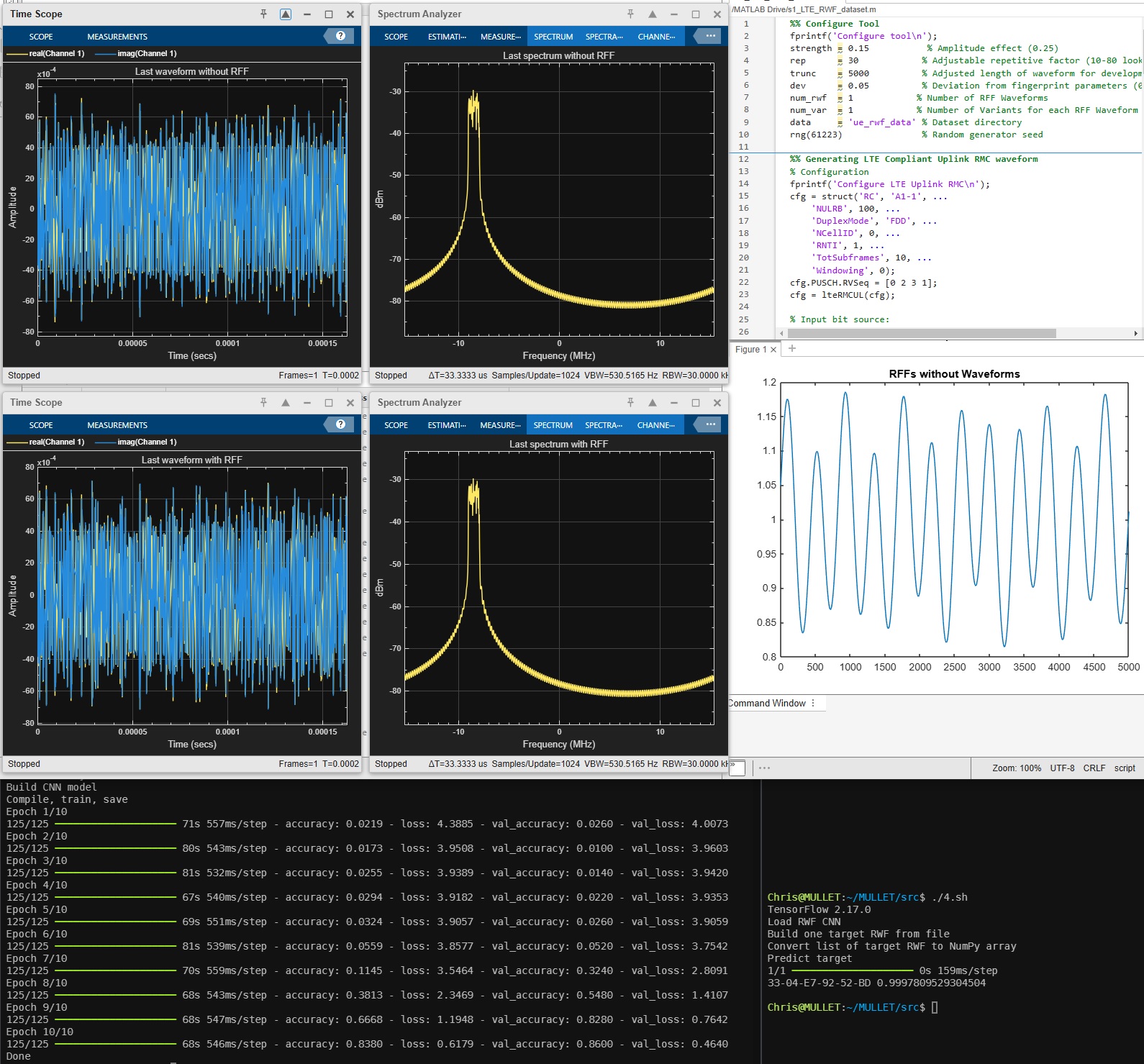
Simulated RF Fingerprints (RFF) are generated by random parameters (that are likely unique) of a sine and cosine combination. Their effect on the base Reference Measurement Channel (RMC) waveform generated by LTE ToolBox is then the RFF Waveforms (RWF). They can be illustrated on the MATLAB GUI by uncommenting plot, timescopes and spectrum analyzers with and without the RFFs applied
Inputs
Repetitive factor of sine and cosine combination (e.g. 25)
Strength percentage of RF Fingerprint (e.g. 15)
Outputs
25x15_ue_rwf_data Dataset directory of different devices given by MAC addresses, each with RWFs in numerically named files
25x15_ue_rwf_data_cmplx A similar dataset, only in complex SigMF NumPy format as numerically named files, for use with the web service
25x15_ue_rwf_parms.asc Dataset’s MAC addresses and the associated characteristic parameters for their RWF
s2_BuildTrainCNN.py
RWFs are applied to build the Convolutional Neural Network (CNN)
Inputs
Repetitive factor of sine and cosine combination (e.g. 25)
Strength percentage of RF Fingerprint (e.g. 15)
Outputs
25x15_rwf_cnn.keras CNN built from the RWF dataset by Keras API for TensorFlow
25x15_rwf_cnn_norm.asc Normalization factor of CNN
25x15_mac_label_enc.pkl MAC labels encoded to numerical representation needed by the CNN
s3_LTE_RWF_test.m
A set of RWF characteristic parameters from ue_rwf_parms.asc may be chosen for variables A, B, C, D, J and K and passed into the MATLAB script. Then this step will generate a target variant RWF with marginal deviations. Take note of the UE’s associated MAC address, but observe that NO definite MAC address will be passed into the next step (just the label encoding of all MAC addresses)
Inputs
Repetitive factor of sine and cosine combination (e.g. 25)
Strength percentage of RF Fingerprint (e.g. 15)
Parameters of test RF Fingerprint (use format similar to ue_rwf_parms.asc)
Outputs
25x15_target_rwf.asc Target RWF that may differ slightly from one in the RWF CNN
s4_MatchUEbyRWF.py
Model predicts the target RWF, decodes its associated label and finds the corresponding probability
Inputs
Repetitive factor of sine and cosine combination (e.g. 25)
Strength percentage of RF Fingerprint (e.g. 15)
Outputs
Returns the MAC address of the UE that most closely matches its RWF to the test target and the confidence of its answer
Experimentation
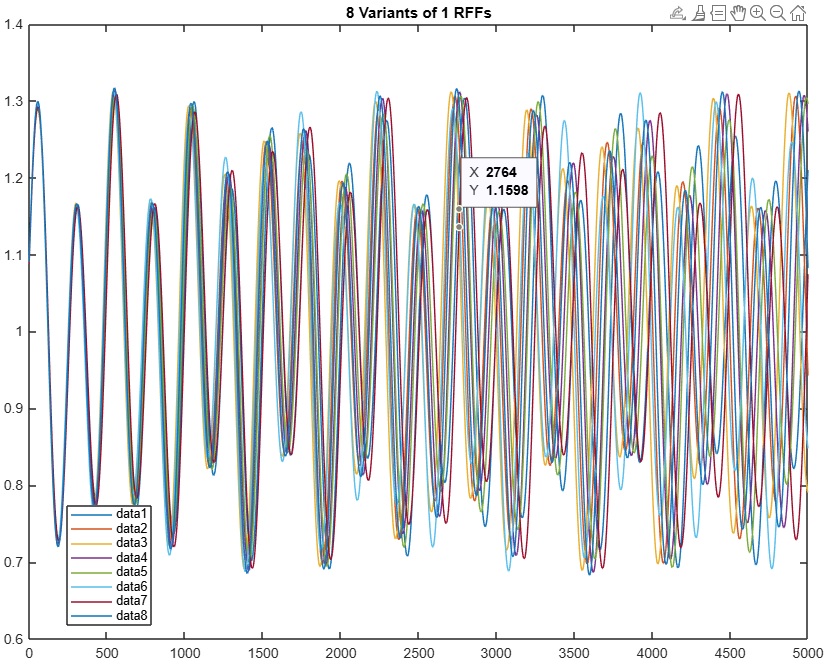
Eight variants by 5% of one RF Fingerprint
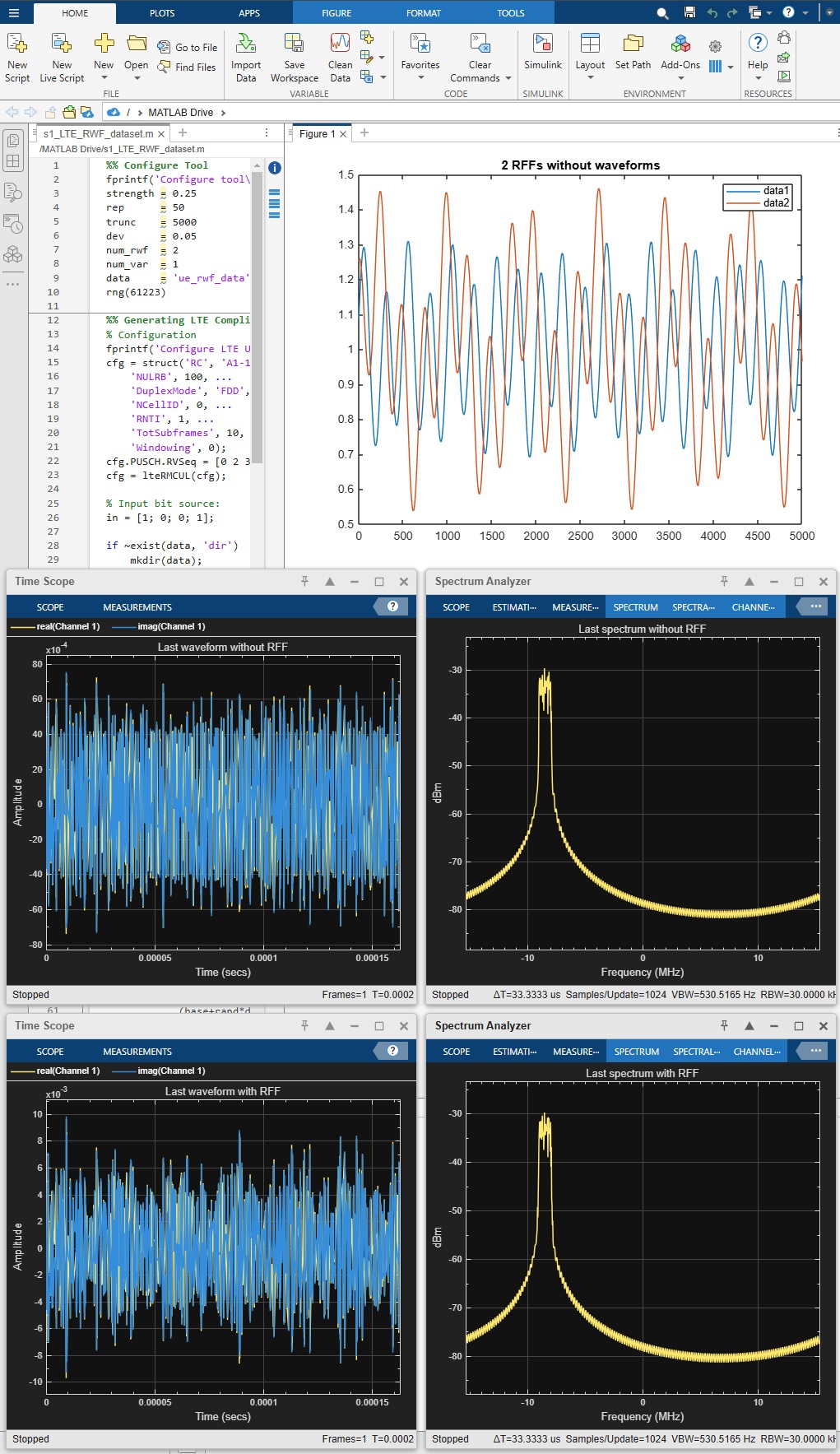
Two different RFFs. Waveform with and without an applied RFF. Their corresponding Spectrum Analyzers still match
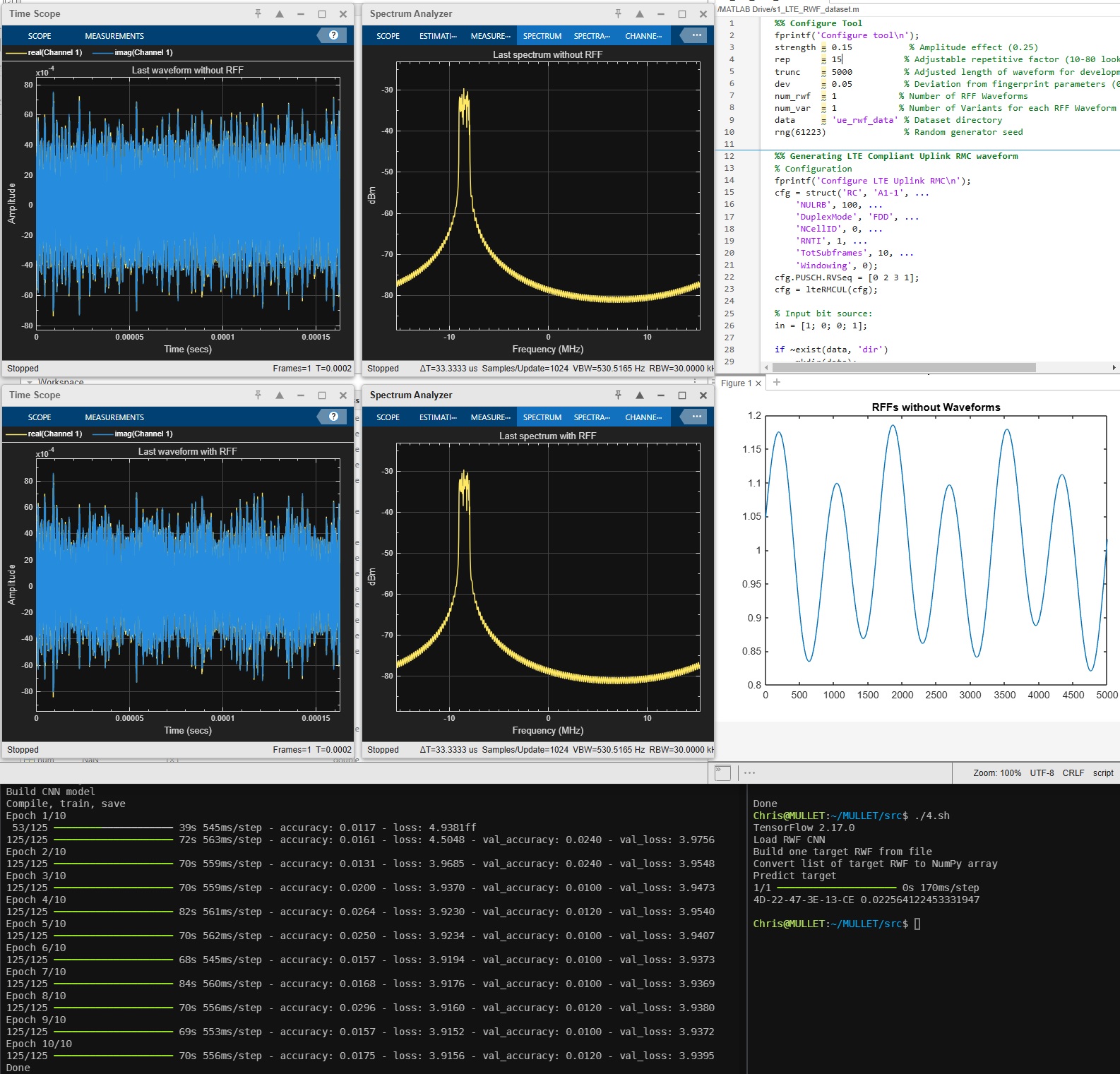
Repetitive 15, Strength 15% results in confidence of 2% in the incorrectly guessed UE match
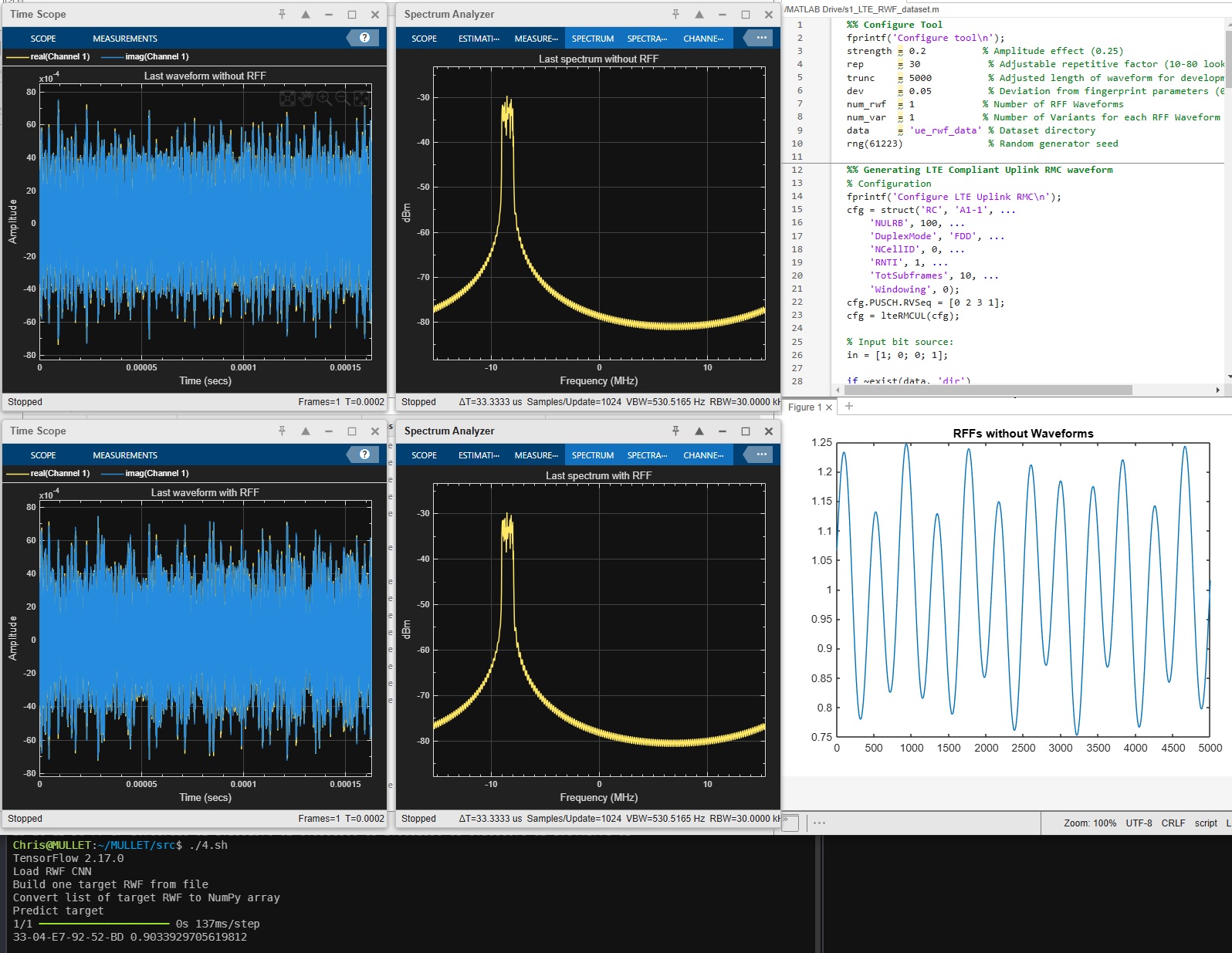
Repetitive 30, Strength 20% results in confidence of 90% in the correctly guessed UE match
Repetitive 30, Strength 15% results in confidence of 99% in the correctly guessed UE match
all.sh result
               repetition
                 10    15    20    25    30    35
          .10   0.33x 0.02x 0.04x 0.03x 0.02x 0.02x

          .15   0.02x 0.02x 0.02x 0.02x 0.57  0.09x
strength
          .20   0.02x 0.22x 0.59  0.99  0.99  0.02x

          .25   0.99  0.99  0.99  0.95  0.12x 0.99

          .30   0.99  0.99  0.99  0.99  0.99  0.99

          .35   0.70  0.99  0.99  0.99  0.15x 0.02x
Notes
Numbered scripts may be used to invoke steps
./1.sh 25 15
./2.sh 25 15
./3.sh 25 15 1.3e-02 1.5e-02 5.6e-03 1.3e-02 1.4e-01 4.6e-02
./4.sh 25 15
Nested loops that test a range of repetitive factors by a range of strengths
./all.sh
To run in the background without terminating even if logging out
nohup ./all.sh > 20241108_0221_all.log &
And viewing that log as it is generated. Ctrl-C only terminates the view, not the process
tail -fn+0 20241108_0221_all.log
To clear all generated files that Git does not control, including dataset or .keras
git clean -fdx
Example on how to restore current baseline of edited file
git restore s1_LTE_RWF_dataset.m
How to restore current baseline of all controlled code
git restore :/
Truncating is necessary due to limits of CPU and memory
Ultimately, this kind of CNN ML can be extended to any wireless platform. LTE was only applied here to demonstrate the principle of RF Fingerprint recognition
To Do
Restore applicable impairments
Can eventually test with two hardware SDRs